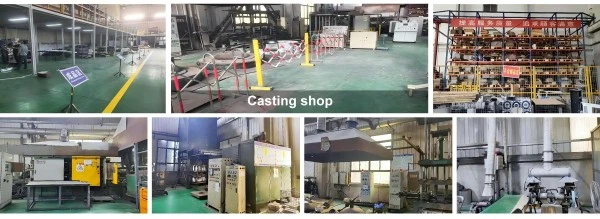
Technology Principle: Unveiling the Core Mechanics
Gravity Casting: Harnessing Natural Forces
Gravity casting, as its title proposes, depends on the principal drive of gravity to fill molds with liquid metal. This time-honored method has been a foundation of metallurgy for centuries, esteemed for its straightforwardness and cost-effectiveness. In this handle, liquid metal is poured from a scoop or heater into a shape depression, where it cements to frame the craved shape.
The excellence of gravity casting lies in its flexibility. It can be utilized with a wide extend of metals and amalgams, from aluminum and copper to press and steel. The prepare, along with low pressure casting, is especially well-suited for creating huge, straightforward shapes with moderately moo generation volumes. In any case, it's not without its confinements – the dependence on gravity alone can in some cases lead to deficient shape filling, particularly in complex or thin-walled parts.
Low Pressure Casting: Precision Through Pressure
Low weight casting, on the other hand, presents a controlled component of drive to improve the filling handle. This strategy utilizes a fixed heater associated to a form depth through a riser tube. By applying moo weight (regularly 0.3 to 1.5 bar) to the surface of the liquid metal in the heater, it's tenderly pushed up through the riser tube and into the mold.
This procedure offers a few focal points over gravity casting. The controlled fill rate comes about in a more uniform hardening prepare, decreasing the chance of absconds. It's especially successful for creating complex, thin-walled components with tall dimensional precision. low pressure casting sparkles in applications requiring high-quality surface wraps up and steady mechanical properties.
Key Process Parameters Comparison: Fine-Tuning for Optimal Results
Mold Design and Material
In gravity casting, form plan is generally direct, frequently utilizing sand or changeless molds. The effortlessness of the handle permits for fast turnaround times and lower tooling costs. Be that as it may, this effortlessness can restrain the complexity of parts that can be produced.
Low weight casting ordinarily utilizes more advanced form plans, regularly made from steel or other strong materials. These molds can join complex cooling frameworks and gating plans, permitting for the generation of complex parts with tight resiliences. The beginning venture in form plan and creation is higher, but it pays off in terms of portion quality and consistency.
Metal Temperature and Flow Rate
Controlling metal temperature is significant in both forms, but the challenges contrast. In gravity casting, keeping up the ideal pouring temperature all through the prepare can be precarious, as the metal cools amid exchange from the heater to the shape. This can lead to varieties in hardening rates and potential defects.
Low weight casting offers more exact control over metal temperature and stream rate. The fixed heater keeps up a reliable temperature, whereas the pressure-controlled fill permits for a consistent, controllable stream rate. This comes about in more uniform hardening and way better generally portion quality.
Pressure and Cycle Time
Gravity casting relies solely on atmospheric pressure, which limits the speed and consistency of mold filling. Cycle times can vary depending on part complexity and size, but are generally longer than those in low pressure casting.
Low pressure casting introduces the variable of applied pressure, typically ranging from 0.3 to 1.5 bar. This allows for faster, more controlled filling of the mold cavity. Cycle times are generally shorter and more consistent, contributing to higher production efficiency.

Casting Quality & Defect Risk: Navigating the Challenges
Surface Finish and Dimensional Accuracy
Gravity casting can create great surface wraps up, but comes about can be conflicting, particularly with complex geometries. Dimensional exactness is by and large lower than in low pressure casting, due to the less controlled nature of the shape filling process.
Low weight casting exceeds expectations in creating parts with great surface wraps up and tall dimensional precision. The controlled fill and cementing handle comes about in less surrenders and more steady portion quality. This makes it especially reasonable for applications requiring tight resistances and smooth surfaces.
Common Defects and Mitigation Strategies
In gravity casting, common defects include porosity, shrinkage cavities, and incomplete filling. These issues often stem from turbulent metal flow, uneven cooling, and the limitations of relying solely on gravity for mold filling. Mitigation strategies include careful gating and riser design, optimizing pouring temperatures, and using chills to control solidification.
Low pressure casting is less prone to these defects, thanks to its controlled fill process. However, it's not immune to issues. Potential defects include gas porosity (from trapped air in the mold) and oxide inclusions. These can be mitigated through proper mold design, effective degassing of the molten metal, and maintaining clean, oxide-free metal in the furnace.
Material Properties and Mechanical Performance
The hardening prepare in gravity casting can lead to varieties in fabric properties over the portion, especially in bigger castings. This can result in conflicting mechanical performance.
Low weight casting by and large produces parts with more uniform fabric properties and superior mechanical execution. The controlled cementing handle permits for better grain structures and decreased porosity, driving to made strides quality and durability.
Both gravity casting and low pressure casting have their place in modern manufacturing. Gravity casting offers simplicity and cost-effectiveness for larger, less complex parts. Low pressure casting provides superior quality and consistency, especially for intricate, high-performance components. The choice between the two depends on factors such as part geometry, production volume, quality requirements, and budget constraints.

Low Pressure Casting Supplier: Rongbao Enterprise
At Rongbao, we get it the special needs of different businesses, counting car, aviation, therapeutic gear, and electrical and electronic fabricating. Our commitment to brilliance is apparent in our ISO 9001:2016 Quality Administration Framework, ISO 14001 Natural Administration Framework, and ISO 45001 Word related Wellbeing and Security Administration Framework certifications.
Whether you require utilitarian components like cast hub stream fan adornments and impellers, or tasteful pieces such as casting create gifts, our group has the ability and capability to convey. We pride ourselves on sensible taken a toll control, steady and convenient conveyance, controllable item quality, and extraordinary after-sales service.
Reach out to Steve Zhou at steve.zhou@263.net or Zhou Yi at zhouyi@rongbaocasting.com. Let's work together to bring your casting ventures to life with exactness and quality.