- English
- French
- German
- Portuguese
- Spanish
- Russian
- Japanese
- Korean
- Arabic
- Greek
- German
- Turkish
- Italian
- Danish
- Romanian
- Indonesian
- Czech
- Afrikaans
- Swedish
- Polish
- Basque
- Catalan
- Esperanto
- Hindi
- Lao
- Albanian
- Amharic
- Armenian
- Azerbaijani
- Belarusian
- Bengali
- Bosnian
- Bulgarian
- Cebuano
- Chichewa
- Corsican
- Croatian
- Dutch
- Estonian
- Filipino
- Finnish
- Frisian
- Galician
- Georgian
- Gujarati
- Haitian
- Hausa
- Hawaiian
- Hebrew
- Hmong
- Hungarian
- Icelandic
- Igbo
- Javanese
- Kannada
- Kazakh
- Khmer
- Kurdish
- Kyrgyz
- Latin
- Latvian
- Lithuanian
- Luxembou..
- Macedonian
- Malagasy
- Malay
- Malayalam
- Maltese
- Maori
- Marathi
- Mongolian
- Burmese
- Nepali
- Norwegian
- Pashto
- Persian
- Punjabi
- Serbian
- Sesotho
- Sinhala
- Slovak
- Slovenian
- Somali
- Samoan
- Scots Gaelic
- Shona
- Sindhi
- Sundanese
- Swahili
- Tajik
- Tamil
- Telugu
- Thai
- Ukrainian
- Urdu
- Uzbek
- Vietnamese
- Welsh
- Xhosa
- Yiddish
- Yoruba
- Zulu
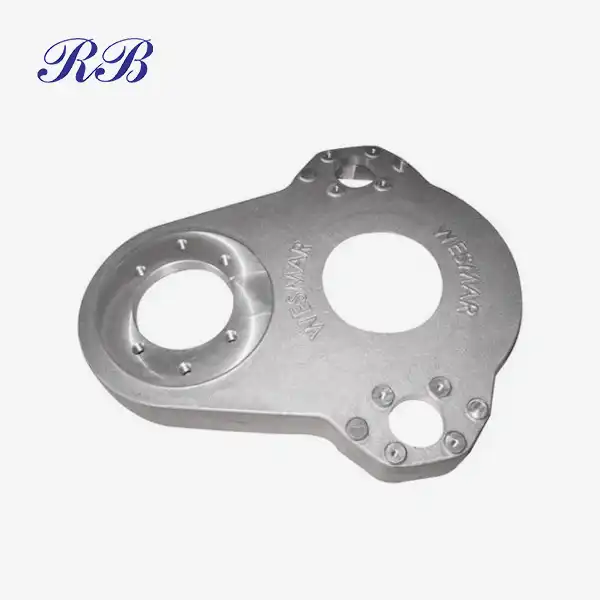
Cast Flange
2. Material: A356
3. Weight: 2.3kg
4. Process: Low casting
5. Certification: ISO9001:2015, ISO14001, ISO45001
6. Transportation packaging:en box
7. Mechanical processing: CNC machining
8. Surface treatment: Shot blasting
9. OEM/ODM: Customized
10. Production capacity:5000 pieces
11. Specification: Customized
12. Origin: Xi'an, China
Cast Flange: Precision-Engineered Aluminum Components for Pressure Vessel Applications
Shaanxi Rongbao Machinery Electronics Co., LTD. specializes in manufacturing high-performance Cast Flange components using advanced low-pressure casting technology. Our A356 aluminum alloy flanges are specifically designed for pressure vessel covers, combining exceptional strength with lightweight properties. With a production capacity of 5,000 pieces per batch and a unit weight of 2.3kg, our products meet demanding industrial requirements.
Backed by 14 utility model patents and ISO 9001:2015, ISO 14001, and ISO 45001 certifications, we deliver reliable components to global markets. Our integrated manufacturing approach—from mold development through CNC machining and shot blasting surface treatment—ensures consistent quality for equipment manufacturers worldwide.

Understanding Cast Flange Manufacturing
Products are key links in pressure vessel systems and piping applications. The products provide outstanding design freedom and cost effectiveness for complex geometries, as compared to forged options.
Molten A356 aluminium alloy is injected into precision moulds at controlled pressure, usually 2-15 psi, in the low pressure casting method. This results in denser and stronger castings with less internal flaws than gravity casting.
Your application benefits from aluminum's inherent corrosion resistance and light weight. The A356 alloy has good mechanical characteristics required for pressure applications.
Technical Specifications
|
Parameter
|
Details
|
|
Material
|
A356 Aluminum Alloy
|
|
Weight
|
2.3 kg
|
|
Manufacturing Process
|
Low-Pressure Casting
|
|
Mechanical Processing
|
CNC Machining
|
|
Surface Treatment
|
Shot Blasting
|
|
Production Capacity
|
5,000 pieces
|
|
Application
|
Pressure Vessel Cover
|
|
Customization
|
OEM/ODM Available
|
|
MOQ
|
Approximately 100 pieces
|
|
Lead Time
|
20-30 working days
|
|
Origin
|
Xi'an, China
|
|
Certifications
|
ISO 9001:2015, ISO 14001, ISO 45001
|
Manufacturing Process Excellence
Our low pressure casting method results in better density and mechanical strength in each one of the flange components. The process starts with precise mould making, which takes around 15-25 days to build unique tooling.
The molten A356 aluminium is kept at tight control at the optimum temperatures. Gradually apply pressure from below. The mould cavity is filled entirely with less entrapped gas and less porosity.
Each casting is CNC machined to tight dimensional specifications once solidified. We machine to accuracy to ensure correct mating surfaces and bolt hole alignment.
Surface treatment is then carried out by shot blasting, which produces a uniform finish and removes oxidation. This preparation promotes coating adherence for any required additional surface protection in your specific environment.
Material Properties and Performance
A356 aluminium alloy is the best compromise of castability, strength and corrosion resistance. The alloy contains silicon and magnesium which gives good fluidity in casting and reactivity to heat treatment.
Your parts can benefit from the thermal conductivity of aluminium, therefore these flanges are good for applications with temperature changes. The material is stable across a large operating range.
The reduced weight decreases structural loading and installation difficulty. Handling and assembly is easier at 2.3kg per unit than with steel equivalents.
Corrosion resistance is an advantage for chemical processing, maritime applications and outdoor installations. The natural oxide coating protects the base metal from deterioration.

Customization Capabilities
We can provide OEM and ODM production according to your demands. Whether you provide CAD designs, 3D models or application specifications, our engineering team turns your requirements into production-ready components.
With our multi-process capabilities of high pressure die casting, gravity casting and sand casting, we can offer the best manufacturing method for your unique needs.
Normally, after the mould is completed, batch manufacturing will take 7 to 20 days. This efficiency aids your project schedules without sacrificing quality.
Custom specifications can accommodate special pressure ratings, connector configurations or dimensional constraints. Our technical staff is with you throughout the development process.
Quality Assurance System
We work to an ISO 9001:2015 certified quality management system at all stages of production. Incoming material examination checks the alloy composition and purity before casting.
Process controls include casting temperature monitoring, timing of pressure application, and cooling rates. These parameters directly affect final component integrity and mechanical qualities.
Coordinate measuring equipment is used for dimensional inspection to verify machined features fall within drawing tolerances. Surface finish measurements ensure consistency of each production batch.
Our ISO 14001 and ISO 45001 certifications for environment and safety management are the proof of our responsible production processes.
Global Supply Experience
Approximately 70% of our production exports to the United States, Europe, Japan, and other international markets. This global reach reflects our understanding of diverse technical standards and customer expectations.
We've successfully passed stringent supplier audits from multinational corporations, including ABB's SSBM evaluation. These assessments validate our technical capabilities and management systems.
Transportation packaging utilizes carton boxes designed to protect components during international shipping. Packaging configuration can be customized based on your receiving facility requirements.
Our delivery performance maintains consistency, with customers reporting that on-time shipments support their production schedules without delays.
Application Guidance
Cast flanges excel in pressure vessel applications where weight reduction and corrosion resistance provide operational advantages. Consider these components for vessel covers, access ports, and connection points.
The low-pressure casting process suits medium-volume production where component quality takes priority over maximum production speed. This balance serves equipment manufacturers seeking reliable suppliers for ongoing programs.
Aluminum's non-magnetic properties benefit applications in sensitive environments where ferrous materials create interference. Electronic equipment housings and instrumentation systems represent additional use cases.
Thermal management applications leverage aluminum's conductivity to dissipate heat efficiently. Heat exchanger connections and thermal equipment benefit from these material characteristics.

FAQ
Q: What is the minimum order quantity for custom product components?
A: Our standard MOQ is approximately 100 pieces. This quantity balances mold development costs with production efficiency while remaining accessible for specialized projects.
Q: How does low-pressure casting compare to gravity casting for flange production?
A: Low-pressure casting produces denser castings with superior mechanical properties and fewer defects compared to gravity casting. The controlled pressure fills the mold more completely, reducing porosity and improving structural integrity.
Q: Can you accommodate specific material certifications or testing requirements?
A: Yes, we can provide material certificates and arrange additional testing such as pressure testing, X-ray inspection, or mechanical property verification based on your specifications.
Q: What dimensional tolerances can your CNC machining achieve?
A: Our precision machining capabilities typically achieve tolerances of ±0.1mm for critical dimensions. Tighter tolerances can be discussed for specific features based on your application requirements.
Q: Do you provide technical support for flange design optimization?
A: Our engineering team offers design consultation to optimize castability, reduce weight, or improve performance. We can review your designs and suggest modifications that enhance manufacturability while maintaining functionality.
Contact Us
Ready to discuss your Cast Flange requirements? Reach out to steve.zhou@263.net today to start your custom project.
Learn about our latest products and discounts through SMS or email