- English
- French
- German
- Portuguese
- Spanish
- Russian
- Japanese
- Korean
- Arabic
- Greek
- German
- Turkish
- Italian
- Danish
- Romanian
- Indonesian
- Czech
- Afrikaans
- Swedish
- Polish
- Basque
- Catalan
- Esperanto
- Hindi
- Lao
- Albanian
- Amharic
- Armenian
- Azerbaijani
- Belarusian
- Bengali
- Bosnian
- Bulgarian
- Cebuano
- Chichewa
- Corsican
- Croatian
- Dutch
- Estonian
- Filipino
- Finnish
- Frisian
- Galician
- Georgian
- Gujarati
- Haitian
- Hausa
- Hawaiian
- Hebrew
- Hmong
- Hungarian
- Icelandic
- Igbo
- Javanese
- Kannada
- Kazakh
- Khmer
- Kurdish
- Kyrgyz
- Latin
- Latvian
- Lithuanian
- Luxembou..
- Macedonian
- Malagasy
- Malay
- Malayalam
- Maltese
- Maori
- Marathi
- Mongolian
- Burmese
- Nepali
- Norwegian
- Pashto
- Persian
- Punjabi
- Serbian
- Sesotho
- Sinhala
- Slovak
- Slovenian
- Somali
- Samoan
- Scots Gaelic
- Shona
- Sindhi
- Sundanese
- Swahili
- Tajik
- Tamil
- Telugu
- Thai
- Ukrainian
- Urdu
- Uzbek
- Vietnamese
- Welsh
- Xhosa
- Yiddish
- Yoruba
- Zulu
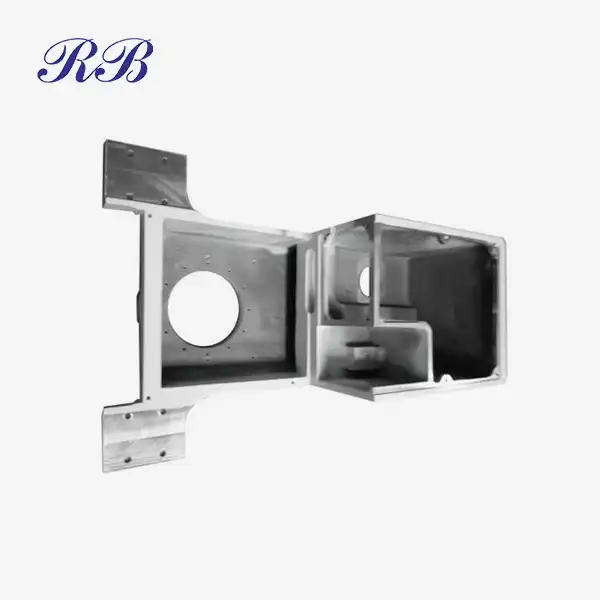
How to make a casting connecting frame for an industrial robotic support arm?
Robots that weld cars or palletize boxes earn their accuracy from one quiet casting connecting frame that ties the support arm to the base or the tool flange. The frame absorbs reversing inertial loads, holds a mounting face flat to a fraction of a tenth of a millimeter at the tool centre point, and survives millions of cycles on a dirty shop floor.
This guide explains why the connecting frame is the part a robot's repeatability rests on, how a 9.5 kg A356-T6 frame is poured, and what separates a good frame from a bad one.
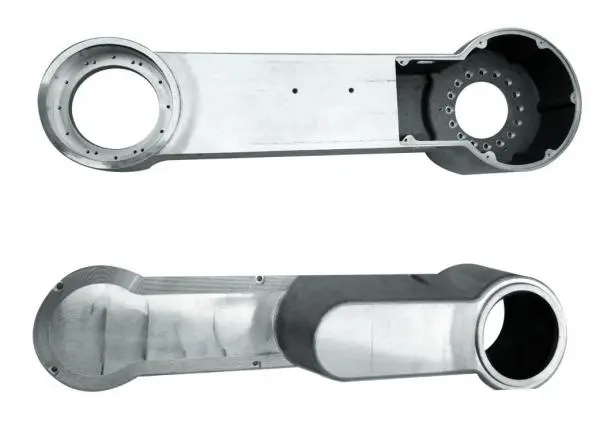
Why the Casting Connecting Frame Is the Backbone of Robotic Performance?
A robotic support arm is a chain of links, and the casting connecting frame is the link the entire chain trusts. It carries static weight, dynamic load from every acceleration, and the reaction moment at every direction change.
Repeatability Starts at the Tool Centre Point
Repeatability is measured at the tool centre point under ISO 9283:1998, not at the joint housing. A casting connecting frame that deflects 0.1 mm under a 200 kg payload pushes the tool tip off target by the same 0.1 mm, enough to fail a tight weld tolerance. A one piece aluminium frame is about 40 percent lighter than a welded steel fabrication of comparable stiffness, so the joint motor sees less inertia; the permanent mould process also gives a more consistent grain structure than a weld seam.
The Frame's Place in the Robot Stack
For a 200 kg payload arm, the casting connecting frame sits between the joint housing and the next link, resisting bending moments from gravity and acceleration. A 9.5 kg A356-T6 frame, machined flat to 0.05 mm on its mounting face and held to ISO 8062-3:2023 general tolerance grade DCTG 8, gives a static stiffness of several hundred newtons per micrometre at the tool flange. Below 8 mm wall thickness the frame becomes hard to fill soundly; above 12 mm you grow shrinkage porosity.
| Item | Typical value for a 200 to 500 kg payload arm |
|---|---|
| Finished mass | 9.5 kg |
| Material | A356.0-T6 per ASTM B26/B26M-18 or ASTM B108/B108M-19 |
| Wall thickness | 8 to 12 mm |
| Machining allowance per ISO 8062-3:2023 | 2 to 3 mm per machined face |
| Tensile, sand cast minimum | 234 MPa |
| Rotating bending fatigue limit at 10 to the 7 cycles | about 90 MPa |
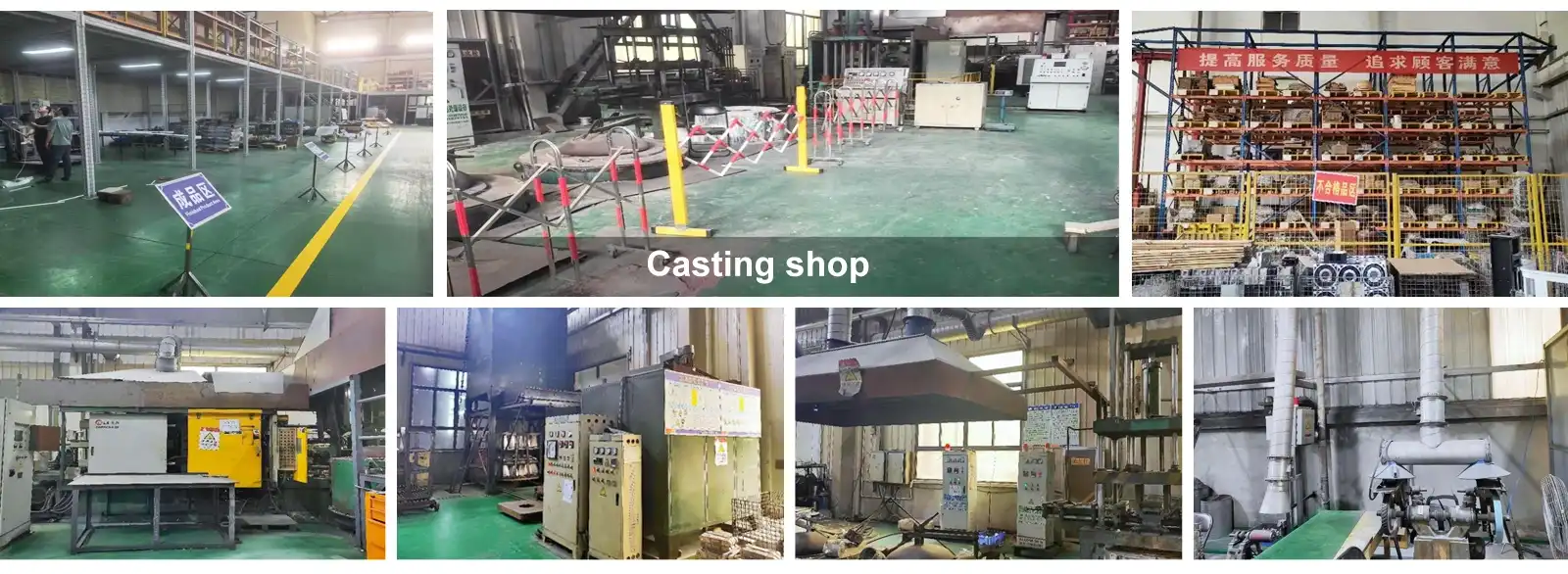
Step by Step Gravity Casting Process for a 9.5 kg Robotic Support Arm Frame
Material choice only matters if the casting connecting frame can be poured soundly and machined cleanly. The next step walks the gravity casting process that turns a 9.5 kg frame from a CAD model into a heat treated, machined, and inspected part.
Pattern, Core, and Mould Fill Strategy
A gravity cast frame begins life as a wooden or resin pattern with 1.5 to 2 degrees of draft and uniform wall thickness in the 8 to 12 mm range. Section changes step in, not out, so solidification runs from the thin web to the thick boss. Internal corners carry a fillet of at least 3 mm to keep the eutectic silicon from forming a stress raiser.
A dry sand core pulls out the inside cavities and is vented at every blind pocket. The mould is closed, preheated to about 200 to 250 °C, and bottom gated through a tapered sprue. Bottom gating keeps oxide films and hydrogen porosity out of a 9.5 kg frame; top gating produces a shower of oxide no downstream step can remove.
- Match plate or cope and drag pattern, resin or aluminium, draft 1.5 to 2 degrees.
- Melt at 720 to 740 °C in a tower furnace, rotary degas with argon to below 0.12 ml per 100 g hydrogen, strontium modify in the 0.02 to 0.04 percent band.
- Pour at 700 to 710 °C through a bottom gate, fill time around 8 to 12 seconds on a 9.5 kg frame.
- Cool 8 to 12 minutes in the mould, then shake out and remove the gating system.
Solidification, Risers, Chills, and T6 Heat Treatment
On a casting connecting frame with bosses of different cross section, the last metal to freeze has to be fed by a riser over the heaviest boss, and the side that freezes first has to be cooled by a chill. Get the directionality wrong and you get shrinkage cavities at the boss roots or cold shuts at the thin webs; the T6 cycle will not rescue either one.
The T6 sequence is the standard solution, quench, age cycle. Solution treatment around 540 °C for several hours dissolves the magnesium silicon phase into a single phase matrix; a water quench at 60 to 100 °C locks that phase into a supersaturated solid solution. Artificial ageing near 155 °C precipitates the magnesium silicon as a fine dispersion, putting the finished casting connecting frame at roughly 262 MPa tensile and about 186 MPa yield.
| T6 step | Range for A356-T6 | What it does, and what it does not |
|---|---|---|
| Solution treat | around 540 °C, several hours | Dissolves Mg2Si into the matrix; cannot fill shrinkage porosity |
| Quench | water at 60 to 100 °C, transfer inside 15 seconds | Retains Mg and Si in solution; can warp thin frames if the quench is uneven |
| Artificial age | around 155 °C, several hours, air cool | Precipitates Mg2Si as a fine dispersion; cannot patch cold shuts or oxide films |
Design and Machining Secrets That Separate Good Frames from Great Ones
Once the casting connecting frame is poured soundly, the next battles are fought in CAD and on the CNC bed. Machining sequence, datum choice, and inspection plan decide whether a part holds tolerance for a million cycles or walks out of spec after fifty thousand.
Datum Strategy and the ISO 8062-3 Tolerance Split
Pick the datums before any metal is cut. On a casting connecting frame, put three cast datums on one face of the mounting boss, then machine that face flat while the part is still referenced to those points. ISO 8062-3:2023 sets the as cast general tolerance at DCTG 8 or DCTG 9 for permanent mould, about 1.5 to 2.0 mm room on unmachined bosses plus 2 to 3 mm machining allowance.
Once those faces are machined, the tolerance tightens by an order of magnitude on the machined surfaces. The as cast surface that nothing touches is held by drawing callouts, not by the CNC, which is where many first article failures start. The drawing must make the split between machined and as cast faces explicit, or the operator picks whichever face is convenient.
Fatigue, Static Compliance, and an Honest Limit
A support arm frame sees a reversing load, so fatigue life matters more than ultimate tensile strength. ASTM E466-21 is the constant amplitude axial fatigue test the data sheet should sit behind. On a 9.5 kg A356-T6 casting connecting frame with a polished machined boss, a 90 MPa rotating bending fatigue limit at 10 to the 7 cycles is a design number, not a marketing claim. ISO 9283:1998 puts a static compliance number on the frame, the deflection per unit load at the tool centre point, which the integrator budgets into cell accuracy.
Gravity casting cannot hold the tolerances a part machined from solid can, and that is the honesty line. If the application demands plus or minus 0.01 mm of repeatability on a clean room frame, or continuous reversing stress above about 120 MPa, gravity casting is the wrong process and a milled billet or a weldment built to a higher inspection class is right. For a typical 200 to 500 kg payload arm, gravity cast A356-T6 lands inside the line at lower cost per part.
Conclusion
Choose a casting connecting frame supplier on the numbers that matter: the A356 melt certificate, the T6 furnace chart, a drawing marked to ISO 8062-3:2023, and a fatigue data set run to ASTM E466-21. The connecting frame is the part the robot's accuracy rests on, and the supplier who hands over all four in one package is the one the cell builder calls first.
FAQs
How does a casting connecting frame usually fail in service?
Most field failures start at a machined boss not properly fed during solidification, at a sharp corner acting as a stress raiser, or at a thread loaded past its insert capacity. Rare catastrophic failures are metallurgical, from cold shuts or oxide folds. Most are design or machining problems that surface as fatigue cracks before any ultimate tensile limit is reached.
What defects can T6 fix, and which can it not?
T6 develops the strength of clean, dense A356 metal into roughly 262 MPa tensile with about 186 MPa yield. It cannot fill shrinkage porosity, weld a cold shut, or push oxide films out of the casting connecting frame. Heat treatment amplifies what the pour delivered; a bad pour makes T6 reveal the problem at the machine tool.
Why does the integrator want a static compliance number?
Static compliance is the deflection per unit load at the tool centre point under ISO 9283:1998. A casting connecting frame that flexes 0.05 mm per 1000 N at the tool flange forces the integrator to budget that flex into the cell accuracy, often a tighter upstream component or a slower cycle. A measured compliance number lets the integrator run at design speed.
When is gravity casting the wrong choice?
Gravity casting hits its ceiling when the tolerance demand drops below plus or minus 0.02 mm across the whole frame, when the load is a continuous reversing stress above roughly 120 MPa, or when the drawing calls for radiographic class 1 across the entire body. A machined billet, a forging, or a weldment built to a higher inspection class becomes the honest answer in those cases.
What should a buyer ask the supplier before the first order?
Ask for the A356 melt certificate with the actual chemistry, the T6 furnace chart, the ISO 8062-3:2023 tolerance grade on the drawing, and an ASTM E466-21 fatigue data set at application stress. A supplier who hands over all four is the supplier the 3D model goes to next.
Casting Connecting Frame Supplier: Rongbao Enterprise
If your project needs a casting connecting frame for a robotic support arm, send us your 3D model or 2D drawing with the annual volume and the service environment the arm runs in. We will run a manufacturability review, recommend A356-T6 or an alternative alloy where the load case calls for it, and return a quotation that names the casting process, heat treatment cycle, machining allowance per ISO 8062-3:2023, and inspection scope.
Our gravity casting line in Xi'an pours A356 frames in the 5 to 12 kg range, machines them on four axis CNC beds, and finishes them with shot blasting and Type II anodizing on request. For a quote and a DFM review within three working days, email zhouyi@rongbaocasting.com or steve.zhou@263.net.
References
- ASTM International. ASTM B26/B26M-18, Standard Specification for Aluminum Alloy Sand Castings. ASTM International, 2018.
- ASTM International. ASTM B108/B108M-19, Standard Specification for Aluminum Alloy Permanent Mold Castings. ASTM International, 2019.
- International Organization for Standardization. ISO 9283:1998, Manipulating Industrial Robots: Performance Criteria and Related Test Methods. ISO, 1998.
- International Organization for Standardization. ISO 8062-3:2023, Geometrical Product Specifications (GPS): Dimensional and Geometrical Tolerances for Moulded Parts, Part 3: General Dimensional and Geometrical Tolerances and Machining Allowances for Castings. ISO, 2023.
- ASTM International. ASTM E466-21, Standard Practice for Conducting Force Controlled Constant Amplitude Axial Fatigue Tests of Metallic Materials. ASTM International, 2021. https://store.astm.org/e0466-21.html
- Kaufman, J. Gilbert, and Elwin L. Rooy. Aluminum Alloy Castings: Properties, Processes, and Applications. ASM International, 2004. ISBN 978-0-87170-803-8
Learn about our latest products and discounts through SMS or email