- English
- French
- German
- Portuguese
- Spanish
- Russian
- Japanese
- Korean
- Arabic
- Greek
- German
- Turkish
- Italian
- Danish
- Romanian
- Indonesian
- Czech
- Afrikaans
- Swedish
- Polish
- Basque
- Catalan
- Esperanto
- Hindi
- Lao
- Albanian
- Amharic
- Armenian
- Azerbaijani
- Belarusian
- Bengali
- Bosnian
- Bulgarian
- Cebuano
- Chichewa
- Corsican
- Croatian
- Dutch
- Estonian
- Filipino
- Finnish
- Frisian
- Galician
- Georgian
- Gujarati
- Haitian
- Hausa
- Hawaiian
- Hebrew
- Hmong
- Hungarian
- Icelandic
- Igbo
- Javanese
- Kannada
- Kazakh
- Khmer
- Kurdish
- Kyrgyz
- Latin
- Latvian
- Lithuanian
- Luxembou..
- Macedonian
- Malagasy
- Malay
- Malayalam
- Maltese
- Maori
- Marathi
- Mongolian
- Burmese
- Nepali
- Norwegian
- Pashto
- Persian
- Punjabi
- Serbian
- Sesotho
- Sinhala
- Slovak
- Slovenian
- Somali
- Samoan
- Scots Gaelic
- Shona
- Sindhi
- Sundanese
- Swahili
- Tajik
- Tamil
- Telugu
- Thai
- Ukrainian
- Urdu
- Uzbek
- Vietnamese
- Welsh
- Xhosa
- Yiddish
- Yoruba
- Zulu
High pressure die casting tonnage calculation
In the realm of high pressure die casting, accurately calculating tonnage is crucial for producing high-quality parts efficiently. This comprehensive guide delves into the intricacies of tonnage calculation, exploring key factors, providing a step-by-step approach, and addressing common challenges. Whether you're new to die casting or looking to refine your process, this article offers valuable insights to optimize your operations.
Factors Influencing Die Casting Tonnage Calculation
Tonnage calculation in high pressure die casting is influenced by numerous variables, each playing a vital role in determining the force required to produce a quality casting. Let's examine these factors in detail:
Projected Area of the Casting
The projected area of the casting is arguably the most critical factor in tonnage calculation. This refers to the total surface area of the casting that will be in contact with the die, projected onto a plane perpendicular to the direction of die closure. A larger projected area naturally requires more force to maintain die closure during the injection process.
For instance, a complex automotive transmission housing with numerous internal cavities and external features will have a significantly larger projected area compared to a simple bracket. Consequently, it will require a higher tonnage to cast effectively.
Material Properties
The characteristics of the molten metal being cast play a substantial role in determining the required tonnage. Different alloys have varying flow characteristics, solidification rates, and thermal properties. Aluminum alloys, such as the widely used A380, behave differently under pressure compared to zinc or magnesium alloys.
For example, aluminum alloy A380, commonly used in motor cover castings and instrument boxes, has a relatively low viscosity when molten. This allows it to flow easily into complex mold geometries but also means it can exert significant pressure on the die, necessitating adequate clamping force to prevent flash.
Injection Pressure
The pressure at which the molten metal is injected into the die cavity directly impacts the tonnage requirement. Higher injection pressures are often used to fill thin-walled sections or intricate details, but they also increase the separating force acting on the die halves.
In the production of thin-walled components like decorative metal castings or gutter support brackets, injection pressures can reach up to 100 MPa or more. This high pressure ensures complete filling of the mold but also demands a proportionally higher clamping tonnage to keep the die closed.
Die Design and Complexity
The design of the die itself, including its size, complexity, and the number of cavities, significantly influences tonnage calculations. Multi-cavity dies, while more productive, require higher tonnages to ensure uniform pressure distribution across all cavities.
Consider a die designed for casting multiple small parts simultaneously, such as accessories for natural gas control valves. Each cavity adds to the total projected area and increases the overall tonnage requirement, even if individual parts are relatively small.
Parting Line Configuration
The parting line - where the two halves of the die meet - is a critical consideration in tonnage calculation. A complex or irregular parting line increases the risk of flash and may require additional clamping force to ensure a tight seal during injection.
For parts with intricate geometries, like cast half circles or motor end covers, careful design of the parting line is essential. A well-designed parting line can help minimize the required tonnage while still ensuring a high-quality, flash-free casting.
Step-by-Step Guide to Calculating Tonnage in High Pressure Die Casting
Calculating the required tonnage for a high pressure die casting operation involves a systematic approach. Follow these steps to ensure accurate tonnage determination:
1. Determine the Projected Area
Begin by calculating the projected area of your casting. This includes not only the part itself but also the runner system, overflows, and any other features that contribute to the area where pressure is applied. For complex geometries, 3D modeling software can be invaluable in accurately determining this area.
Example: Let's say you're casting an aluminum gravity casting part with a projected area of 500 cm². This forms the basis of your tonnage calculation.
2. Consider Material Properties
Factor in the specific properties of the alloy you're using. Different materials require different injection pressures and have varying flow characteristics. Consult material data sheets or conduct flow simulations to determine the optimal injection pressure for your specific alloy and part geometry.
Example: For our aluminum gravity casting part, we might determine that an injection pressure of 70 MPa is suitable based on the alloy properties and part requirements.
3. Calculate the Separating Force
Multiply the projected area by the injection pressure to determine the separating force. This is the force trying to push the die halves apart during injection.
Separating Force = Projected Area × Injection Pressure
Example: 500 cm² × 70 MPa = 3,500,000 N or 350 metric tons
4. Apply a Safety Factor
To account for variables and ensure consistent production, apply a safety factor to your calculated separating force. A common practice is to use a safety factor between 1.1 and 1.5, depending on the complexity of the part and process requirements.
Example: Using a safety factor of 1.2, our required tonnage becomes: 350 tons × 1.2 = 420 metric tons
5. Consider Die Complexity
Adjust your tonnage calculation based on the complexity of your die design. Multi-cavity dies or those with complex parting lines may require additional tonnage to ensure proper closure and prevent flash.
Example: If our die includes multiple cavities for casting several small parts simultaneously, we might increase our tonnage requirement by an additional 10%, bringing the total to 462 metric tons.
6. Verify Machine Capability
Ensure that your chosen die casting machine can provide the calculated tonnage. It's crucial to select a machine that can comfortably meet or exceed your tonnage requirements to ensure consistent, high-quality production.
Example: Based on our calculations, we would need to select a die casting machine with a clamping force of at least 500 metric tons to accommodate our 462-ton requirement comfortably.

Common Challenges in Die Casting Tonnage Calculation and How to Overcome Them
While the process of calculating tonnage for high pressure die casting may seem straightforward, several challenges can arise. Understanding these challenges and knowing how to address them is crucial for maintaining efficient and high-quality production.
Inaccurate Projected Area Calculations
One of the most common pitfalls in tonnage calculation is inaccurately determining the projected area of the casting. This is particularly challenging for complex parts with intricate geometries, such as cast instrument boxes or decorative metal castings.
Solution: Utilize advanced 3D modeling and simulation software to accurately calculate projected areas. These tools can account for complex geometries and provide precise measurements. Additionally, consider breaking down complex parts into simpler geometric shapes and summing their projected areas for a more accurate manual calculation.
Overlooking Material-Specific Factors
Different alloys behave uniquely under pressure and temperature conditions typical of die casting. Failing to account for these material-specific factors can lead to suboptimal tonnage calculations.
Solution: Develop a comprehensive database of material properties for commonly used alloys, such as aluminum die casting alloy A380. Regularly update this database with empirical data from your production runs. Collaborate with material suppliers to obtain the latest information on alloy behavior under various casting conditions.

Underestimating the Impact of Die Design
The design of the die, including factors like parting line configuration and the number of cavities, can significantly affect the required tonnage. Overlooking these design elements often leads to inadequate clamping force.
Solution: Implement a systematic design review process that includes tonnage calculation as a key consideration. Use simulation software to analyze how different die designs impact pressure distribution and required clamping force. For multi-cavity dies, such as those used for small parts like gutter support brackets, ensure uniform pressure distribution across all cavities.
Neglecting Process Variables
Factors such as injection speed, metal temperature, and die temperature can all influence the required tonnage. These variables are often overlooked in initial calculations but can have a significant impact on actual production requirements.
Solution: Develop a comprehensive process parameter matrix that accounts for these variables. Conduct thorough testing and documentation of how changes in these parameters affect required tonnage. Implement real-time monitoring systems to track these variables during production and adjust tonnage calculations accordingly.
Failing to Account for Wear and Tear
Over time, die wear can alter the effective projected area and parting line seal, potentially increasing the required tonnage to maintain part quality.
Solution: Establish a regular die maintenance schedule and inspection protocol. Implement wear-resistant coatings on die surfaces to extend their lifespan. Periodically reassess tonnage requirements for long-running production jobs, adjusting calculations as needed based on observed wear patterns.
High Pressure Die Casting Process Supplier: Rongbao Enterprise
Rongbao Enterprise, founded in 2003, has established itself as a leader in aluminum alloy component solutions.
Our product range includes:
- Aluminum die casting alloy A380 components
- Decorative metal castings
- Cast instrument boxes
- Casting accessories for natural gas control valves
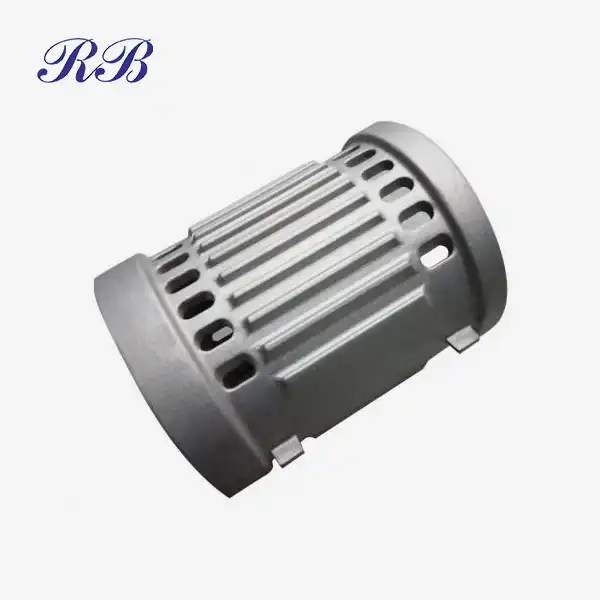
- Casting motor end covers
With a commitment to environmental sustainability, innovation, and precision, Rongbao has earned certifications in Quality Management (ISO 9001:2016), Environmental Management (ISO 14001), and Occupational Health and Safety Management (ISO 45001).
Contact us today:
Email: steve.zhou@263.net or zhouyi@rongbaocasting.com
Let Rongbao Enterprise be your trusted partner in high pressure die casting excellence.
References
- Campbell, J. (2015). Complete Casting Handbook: Metal Casting Processes, Techniques and Design. Butterworth-Heinemann.
- Andresen, B. (2005). Die Casting Engineering: A Hydraulic, Thermal, and Mechanical Process. CRC Press.
- Vinarcik, E. J. (2003). High Integrity Die Casting Processes. John Wiley & Sons.
- Nayak, R. K., & Venkatesan, S. (2021). Die Design and Analysis in High Pressure Die Casting: A Review. Materials Today: Proceedings, 44, 249-252.
- Syrcos, G. P. (2003). Die casting process optimization using Taguchi methods. Journal of Materials Processing Technology, 135(1), 68-74.
Learn about our latest products and discounts through SMS or email