- English
- French
- German
- Portuguese
- Spanish
- Russian
- Japanese
- Korean
- Arabic
- Greek
- German
- Turkish
- Italian
- Danish
- Romanian
- Indonesian
- Czech
- Afrikaans
- Swedish
- Polish
- Basque
- Catalan
- Esperanto
- Hindi
- Lao
- Albanian
- Amharic
- Armenian
- Azerbaijani
- Belarusian
- Bengali
- Bosnian
- Bulgarian
- Cebuano
- Chichewa
- Corsican
- Croatian
- Dutch
- Estonian
- Filipino
- Finnish
- Frisian
- Galician
- Georgian
- Gujarati
- Haitian
- Hausa
- Hawaiian
- Hebrew
- Hmong
- Hungarian
- Icelandic
- Igbo
- Javanese
- Kannada
- Kazakh
- Khmer
- Kurdish
- Kyrgyz
- Latin
- Latvian
- Lithuanian
- Luxembou..
- Macedonian
- Malagasy
- Malay
- Malayalam
- Maltese
- Maori
- Marathi
- Mongolian
- Burmese
- Nepali
- Norwegian
- Pashto
- Persian
- Punjabi
- Serbian
- Sesotho
- Sinhala
- Slovak
- Slovenian
- Somali
- Samoan
- Scots Gaelic
- Shona
- Sindhi
- Sundanese
- Swahili
- Tajik
- Tamil
- Telugu
- Thai
- Ukrainian
- Urdu
- Uzbek
- Vietnamese
- Welsh
- Xhosa
- Yiddish
- Yoruba
- Zulu
Complete OEM Process for Die Cast Drain Valve
If you manage industrial procurement or oversee equipment manufacturing, you already know how much a single unreliable component can disrupt an entire production line. A die cast drain valve sits at the intersection of fluid control, structural integrity, and long-term serviceability — and getting the manufacturing process right makes all the difference. This guide walks through the OEM die casting process for drain valves, covering materials, performance, procurement strategy, and what separates dependable suppliers from the rest.

OEM Die Casting Process for Drain Valves
Custom OEM die cast drain valves are tailor-made fluid control components manufactured via precision die casting processes. By injecting molten metal into hardened steel molds under high pressure, the process delivers mass-producible valve parts with strict dimensional tolerances, uniform structural consistency, and smooth surface finishes, fully meeting standardized assembly requirements for industrial equipment.
Standard Step-by-Step Production Workflow
The standardized OEM die casting workflow ensures consistent quality across every production batch, with each process step strictly controlled and traceable:
- Material Selection: Professional engineers select suitable casting alloys based on the valve’s working pressure, service environment, corrosion resistance requirements and weight limitations. Common options include aluminum, zinc, and magnesium alloys, each matched to specific industrial application scenarios.
- Precision Mold Design and Fabrication: Custom steel molds are precision-machined according to OEM design drawings, covering all core structures including internal fluid channels, threaded connectors, and mounting interfaces. High-precision tooling guarantees zero dimensional deviation for repeated production.
- Pressure Injection and Solidification: Qualified molten alloy is injected into the sealed mold cavity under stable pressure. Controlled rapid cooling forms a dense, fine-grained internal microstructure, effectively enhancing the structural strength and pressure resistance of drain valve bodies.
- Ejection, Trimming and Finishing: Cooled and formed valve parts are ejected from the mold. Excess casting flash is removed through CNC precision machining or shot blasting, and surface treatment is completed to meet assembly and anti-corrosion standards.
- Full-Batch Quality Inspection: Finished products undergo comprehensive tests including dimensional verification, hydraulic/pneumatic pressure testing, and visual surface inspection. Only parts that fully meet OEM specifications are packaged and delivered.

Core Process Advantages for OEM Customization
Different from ordinary standard valves, OEM die cast drain valves support personalized customization of brand-specific structures, unique port layouts and integrated fixing structures. The standardized high-pressure die casting process maintains consistent part accuracy and performance in mass production, avoiding the dimensional inconsistency and low efficiency of traditional manual processing. It perfectly adapts to large-scale assembly line production of industrial equipment.
Materials and Performance Classification of OEM Die Cast Drain Valves
Alloy material selection directly determines the pressure resistance, corrosion resistance, weight and service life of die cast drain valves. Reasonable material matching according to application scenarios is the core premise of reliable valve performance.
Performance Comparison of Common Casting Alloys
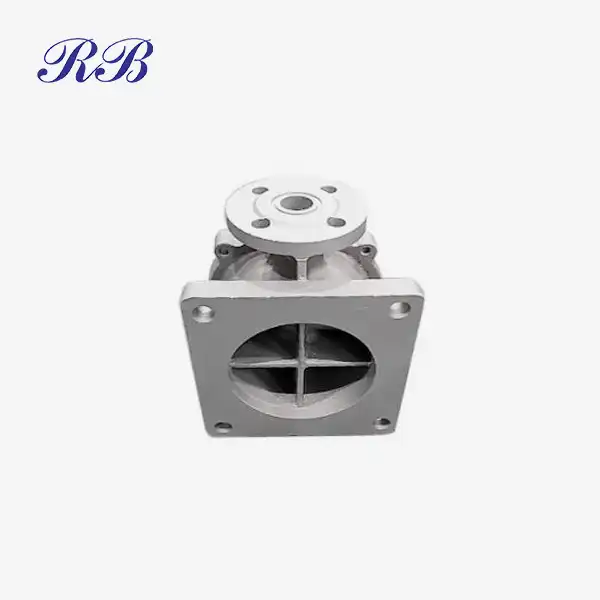
- ADC12 Aluminum Alloy: As the most widely used material for medium-duty drain valves, ADC12 features excellent castability, stable dimensional performance and good corrosion resistance. With moderate structural strength and controllable weight, it is suitable for most industrial fluid control systems. Rongbao Enterprise adopts ADC12 aluminum alloy for mass production of gravity-cast drain valves, with single-component weight stabilized at 4.3kg, balancing structural rigidity and lightweight demands.
- Zinc Alloy: Zinc alloy has superior surface finish and impact strength. Under the same wall thickness, it presents more delicate structural details, making it ideal for small, high-precision drain valve components used in HVAC systems and civil plumbing assemblies.
- Magnesium Alloy: Known as the lightest commercial casting alloy, magnesium alloy greatly reduces the overall assembly weight of equipment. It is mainly used for mobile devices and aerospace auxiliary fluid control systems, but requires professional surface anti-corrosion treatment due to its weak natural corrosion resistance.
Scenario-Based Material Selection Guidelines
For conventional industrial medium-pressure drainage systems, ADC12 aluminum alloy is the most cost-effective and stable choice. For miniature precision assembly scenarios with high surface requirements, zinc alloy is preferred. For lightweight high-end equipment applications, magnesium alloy with customized anti-corrosion treatment can be selected. Procurement teams can match materials according to actual working conditions to avoid performance redundancy or functional insufficiency.
Performance Advantages and Quality Assurance System of OEM Die Cast Drain Valves
The standardized OEM die casting process optimizes the internal structure and surface quality of drain valves, significantly improving operational stability and service life compared with traditional processing methods. A complete quality assurance system further eliminates batch quality risks.
Process-Driven Performance and Durability Improvements
High-pressure injection and rapid cooling form a dense internal microstructure of the valve body, effectively reducing internal porosity and structural defects, and improving pressure resistance and anti-leakage performance. Precision mold forming ensures accurate matching of threaded interfaces and sealing surfaces, avoiding fluid leakage caused by assembly gaps. Uniform surface treatment enhances wear resistance and environmental adaptability, extending the long-term service life of valves in harsh industrial environments.
Full-Chain Standard Quality Assurance Practices
Raw Material Incoming Inspection: Before production, all alloy materials undergo chemical composition and mechanical property testing to ensure compliance with casting standards, eliminating quality risks from raw materials.
High-Precision Dimensional Audit: CMM coordinate measuring machines are used to detect core dimensions such as valve seat diameter, thread pitch and wall thickness, ensuring all parameters are within standard tolerance ranges.
Strict Pressure Resistance Testing: Finished valve bodies undergo hydrostatic or pneumatic pressure tests under rated working conditions to verify zero leakage performance and meet industrial fluid safety standards.
Unified Surface Quality Inspection: Shot blasting treatment forms a uniform matte surface, improving coating adhesion and batch consistency of product appearance and anti-corrosion performance.

Comparative Analysis of Die Cast Drain Valves and Alternative Products
In industrial drainage system applications, brass and plastic drain valves are common alternatives to die-cast aluminum valves, but all have obvious application limitations. OEM die cast drain valves show comprehensive advantages in industrial harsh scenarios.
Defects of Traditional Brass and Plastic Valves
Brass valves have good machinability and antibacterial properties, suitable for potable water systems, but high raw material costs lead to high bulk procurement costs, which is not conducive to large-scale industrial equipment supporting. Plastic valves are lightweight and partial chemical corrosion resistant, but poor high-temperature resistance, UV resistance and pressure resistance make them prone to deformation and aging in industrial long-term operation, with low operational stability.
Comprehensive Advantages of OEM Die Cast Aluminum Valves
Die-cast aluminum drain valves achieve an optimal balance of performance and cost. They are lighter and more cost-effective than brass valves, and stronger and more durable than plastic valves. Combined with gravity casting for complex structures and CNC precision machining for key interfaces, OEM customized products support personalized structural design, with irreplaceable comprehensive advantages in medium and large-batch industrial supporting scenarios.
Bulk and Custom OEM Drain Valve Procurement Strategies
Scientific procurement evaluation and supplier screening are key to obtaining high-quality, cost-effective OEM die cast drain valves, suitable for long-term bulk matching and personalized customized needs.
Core Supplier Evaluation Criteria
- Complete Qualification Certification: Priority shall be given to suppliers with valid ISO 9001 quality management, ISO 14001 environmental management and ISO 45001 occupational safety management certifications to ensure standardized production and compliant quality control.
- Stable Production Capacity: Verify the supplier’s batch production capacity to adapt to peak order demand. Rongbao Enterprise supports a single production run of 5,000 drain valves, with stable delivery capacity for bulk orders.
- Independent R&D and Customization Capability: In-house mold development technology protects customer design IP and supports rapid iteration of customized products, shortening the customization cycle.
- Mature Export Qualification: Suppliers with export experience in European, American and Japanese high-standard markets can meet international industrial quality requirements.
Bulk Order Pricing and Sample Verification Rules
The pricing of OEM die cast drain valves is affected by alloy material, customization complexity, order quantity and logistics mode. For medium and large bulk orders, ADC12 aluminum gravity-cast valves have the highest cost performance with standardized wooden box export packaging. Before formal bulk procurement, enterprises can verify product dimensional accuracy and surface quality through 500-unit sample trial production to avoid batch quality risks.
FAQ
What is the standard production lead time for OEM die cast drain valves?
For standard non-customized die cast drain valves, the bulk production lead time is stable and efficient. For fully customized products requiring new mold development, the lead time includes mold opening, debugging and batch production cycles. The specific delivery cycle can be adjusted according to order quantity and customization complexity.
Which alloy is best for drain valve applications?
ADC12 aluminum alloy is the preferred universal material for most industrial drain valves due to its balanced performance and cost. Zinc alloy is suitable for miniature high-precision valves, and magnesium alloy is exclusively for lightweight high-end equipment scenarios. Material selection needs to be matched with actual working pressure and service environment.
How does shot blasting affect valve surface performance?
Shot blasting removes surface casting burrs and oxide layers, forming a uniform matte surface. It not only improves the appearance consistency of batch products, but also enhances the adhesion of subsequent anti-corrosion coatings, effectively improving the valve’s environmental corrosion resistance and extending service life.
Can existing valve designs be adapted for OEM die casting?
Most mature conventional drain valve structures can be optimized and adapted for die casting production. Professional suppliers can optimize the product structure according to die casting process characteristics, ensuring product performance while improving production efficiency and reducing manufacturing costs.
Conclusion
OEM die casting is the most reliable and cost-effective manufacturing process for industrial drain valves, balancing precision, durability and mass production efficiency. Reasonable material selection, standardized process control and strict quality assurance determine the comprehensive performance of drain valves. Compared with brass and plastic valves, die-cast aluminum OEM products have obvious comprehensive advantages in industrial harsh working conditions. For procurement enterprises, selecting qualified, high-capacity and certified professional suppliers is the key to stabilizing product quality and supply chain efficiency.
Partner with Rongbao Enterprise for Your Next Die Cast Drain Valve Project
Rongbao Enterprise is a professional OEM manufacturer focusing on die cast drain valves and industrial casting components. We hold complete ISO 9001, ISO 14001 and ISO 45001 system certifications, with independent mold R&D, casting production, precision machining and surface treatment capabilities. We support standardized bulk ordering and personalized customized production, with a stable capacity of 5,000 pieces per production run. Adhering to full-process quality control, we provide high-quality, long-service-life die cast drain valve products for global industrial equipment manufacturers, with reliable export service and after-sales guarantee.
Take the next step to make your valve assembly supply chain work better. Email us at steve.zhou@263.net and zhouyi@rongbaocasting.com, if you want to talk about your exact needs and learn how our ability to customize products can help make your product more competitive in the global market.
References
North American Die Casting Association (NADCA). (2022). Die Casting Process and Design Manual.
ASM International. (2021). Aluminum Alloys: Properties and Applications. ASM Handbook, Volume 2.
ISO. (2015). ISO 9001:2015 Quality Management Systems — Requirements.
SGS Group. (2023). Industrial Quality Inspection and Certification Services Report.
Engineering Toolbox. (2023). Valve Materials and Applications: Brass, Aluminum, and Plastics Compared.
Purchasing & Supply Management (ISM). (2023). B2B Procurement Strategies for Industrial Components.
Learn about our latest products and discounts through SMS or email