- English
- French
- German
- Portuguese
- Spanish
- Russian
- Japanese
- Korean
- Arabic
- Greek
- German
- Turkish
- Italian
- Danish
- Romanian
- Indonesian
- Czech
- Afrikaans
- Swedish
- Polish
- Basque
- Catalan
- Esperanto
- Hindi
- Lao
- Albanian
- Amharic
- Armenian
- Azerbaijani
- Belarusian
- Bengali
- Bosnian
- Bulgarian
- Cebuano
- Chichewa
- Corsican
- Croatian
- Dutch
- Estonian
- Filipino
- Finnish
- Frisian
- Galician
- Georgian
- Gujarati
- Haitian
- Hausa
- Hawaiian
- Hebrew
- Hmong
- Hungarian
- Icelandic
- Igbo
- Javanese
- Kannada
- Kazakh
- Khmer
- Kurdish
- Kyrgyz
- Latin
- Latvian
- Lithuanian
- Luxembou..
- Macedonian
- Malagasy
- Malay
- Malayalam
- Maltese
- Maori
- Marathi
- Mongolian
- Burmese
- Nepali
- Norwegian
- Pashto
- Persian
- Punjabi
- Serbian
- Sesotho
- Sinhala
- Slovak
- Slovenian
- Somali
- Samoan
- Scots Gaelic
- Shona
- Sindhi
- Sundanese
- Swahili
- Tajik
- Tamil
- Telugu
- Thai
- Ukrainian
- Urdu
- Uzbek
- Vietnamese
- Welsh
- Xhosa
- Yiddish
- Yoruba
- Zulu
Cast A356 exhaust pipe VS stainless
If an engineering team compares a cast exhaust pipe in A356 aluminum with a welded 316L stainless, it's seldom a question of which is superior. An A356 cast exhaust pipe is about 66% lighter than the same design in stainless, although 316L still wins on long term endurance in chloride rich or continually hot operation. For most buyers the honest response is to match the material to the operating envelope.
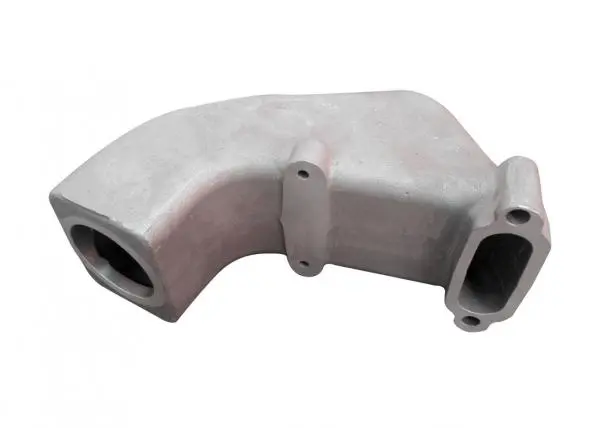
Features of Cast A356 Material Used In Exhaust Systems
The comparison is framed by weight and corrosion, therefore the next issue is why does A356 keep coming up in genuine cast exhaust pipe specs for portable equipment? Aluminum silicon magnesium chemistry, regulated magnesium concentration and a T6 temper combine castability, strength and thermal conductivity that few cast alloys at the same density can equal.
A356 chemistry and the T6 temper
The A356 to ASTM B26 is silicon and magnesium based with strict iron, copper, manganese, zinc and titanium limits. Silicon offers the melt fluidity so that narrow walls may be filled. Magnesium allows the T6 temper to acquire strength. The low impurity ceiling prevents the formation of brittle intermetallics during thermal cycling. ASTM B26 Manufactured to:
- Silicon 6.5 to 7.5 per cent
- Magnesium 0.25 to 0.45 percent
- Iron 0.20% max
- Copper limit 0.20 per cent
- Manganese, zinc, titanium 0.10 to 0.20 percent max each, balance aluminum
The T6 cycle is a 3 stage process: solution treat at 540°C, water quench, and artificial age around 155°C. The procedure introduces fine magnesium silicide precipitates to the matrix that provide the T6 cast exhaust pipe with the rated tensile and yield .
Weight and mechanical data
A356 has a density of 2.68 g/cm3 compared to 8.0 g/cm3 for 316L therefore a cast exhaust pipe that weighs 3.6 kg in stainless reduces to roughly 1.2 kg in aluminum, a reduction of about 2.4 kg per piece. T6 is 234 MPa min tensile per ASTM B26 with 165 MPa min yield. Typical T6 is around 262 MPa tensile and 186 MPa yield with 5 to 8 percent elongation and Brinell in the range of 75 to 80. The thermal conductivity of about 151 W/(m·K) is almost ten times that of stainless, thus the part releases heat away from downstream gaskets after a cold start, instead of holding it there.

How Does a Stainless Steel Exhaust Pipe Work?
The last part was when A356 fits; this one is the case for when a 316L stainless welded exhaust pipe is the proper solution. Starting point for exhaust pipe service is stainless steel when exposed to chloride, road salt, maritime spray or persistent temperatures well above 200 degrees C.
How a stainless exhaust pipe is built
A typical 316L stainless exhaust pipe is not a casting but a fabrication: tube or sheet produced, seam welded, flanges welded on, then bent to the routing geometry. Stainless exhaust work is a multi stage process with lengthier lead times for this reason . Each weld has to be certified , passivated and tested to keep corrosion resistance intact . Opting for stainless instead of aluminum adds greater unit cost and a more difficult supplier audit.
316L properties at temperature and in corrosion
316L annealed has a minimum tensile strength of 515 MPa and a minimum yield strength of 205 MPa and a continuous service ceiling of 870 degrees Celsius. The 2 to 3 percent molybdenum provides a pitting resistance equivalent rating over 24 to withstand pitting in chloride when 304 stainless would pit. An A356 cast exhaust pipe is the incorrect option for a chloride-laden or continually hot installation, and to tell you differently does a disservice to a customer working from an actual spec sheet.

Gravity Casting vs. Traditional Methods: A Comparison
The durability argument for stainless and the weight argument for A356 are the same question: Which technique produces a sound cast exhaust pipe with the surface a consumer requires. Gravity casting is the solution . It out performs high pressure die casting and the multi step stainless approach .
Process differences for cast exhaust pipe production
Gravity casting is the process of pouring liquid A356 into a sand or permanent mold under its own weight . No high pressure injection . No trapped gas . This leads to a more dense portion with lower inner voids and a more homogeneous microstructure after T6. Tooling is cheaper than a comparable sized high pressure die cast die, cycle rates of 5 to 15 minutes per item allow batch sizes from dozens to low thousands and pattern modifications cost a lot less than cutting a new die. Gravity cast A356 is more accessible to a bespoke geometry than several other methods.
Dimensional control and surface finish
On key sealing surfaces of a cast exhaust pipe, plus or minus 0.3 mm tolerance is feasible direct from the mold, with CNC reserved for flange faces and gasket lands. After shot blasting the surface polish is Ra 3.2 micrometers, clean enough for several slip joints and a suitable platform for additional coating. CNC cutting speeds on A356 range 300 to 500 m/min compared to 150 to 200 m/min on stainless.
Cost Analysis And the Economics of Production
The only honest approach to compare cost between an A356 cast exhaust pipe and a 316L stainless one is by ratio not absolute price as metal prices vary with the market each quarter. As a rule of thumb stainless raw material will cost 1.7 to 2.0 times the price per kilogram of A356 and the difference grows after machining time, weld qualification and freight weight per piece are factored in.
A cast exhaust pipe in A356 when produced in batch sizes from 200 to 2000 pieces will cost on a finished part basis around 40 to 60 percent of a comparable fabricated stainless item. Sea freight is the lever many buyers miss: 1000 aluminum parts at 1.2kg each weighs around 1.2t, 1000 stainless counterparts at 3.6kg each weighs 3.6t, thus crate cost and loading almost doubles. The ratio holds: A356 is the cheaper cost path for less critical exhaust pipe designs, stainless the lower risk route when corrosion or temperature rules out aluminum.
|
Cast A356 exhaust pipe vs. 316L stainless exhaust pipe: ratio based comparison |
||
|
Factor |
A356 cast exhaust pipe |
316L stainless exhaust pipe |
|
Part weight, identical geometry |
about 1.2 kg |
about 3.6 kg |
|
Density |
2.68 g/cm3 |
8.0 g/cm3 |
|
Tensile strength |
234 MPa min, about 262 MPa typical T6 |
515 MPa min annealed |
|
Yield strength |
165 MPa min, about 186 MPa typical T6 |
205 MPa min |
|
Elongation |
about 5 to 8 percent |
about 40 percent annealed |
|
Brinell hardness |
about 75 to 80 |
about 187 max annealed |
|
Thermal conductivity |
about 151 W/(m·K) |
about 16 W/(m·K) |
|
Continuous service ceiling |
below 200 degrees Celsius sustained with chloride risk |
near 870 degrees Celsius |
|
Raw material cost ratio |
baseline 1.0 |
about 1.7 to 2.0 |
|
Process steps to a finished part |
cast, T6 heat treat, machine, blast |
cut, form, weld, machine, passivate |
|
Typical CNC cutting speed |
300 to 500 m/min |
150 to 200 m/min |
Conclusion
The choice between A356 cast exhaust pipe and 316L stainless welded exhaust pipe is very much a question of operating environment, weight budget and order size. For portable generator exhaust, smoke exhaust ducting on fire fighting equipment and similar geometries under 3kg, A356 in T6 is the lower weight and lower cost approach, providing service remains below 200 deg C and away from continuous chloride exposure. When the exhaust pipe is installed in a maritime cabin, near a chlorinated washdown or on a continually hot stack, 316L is still the correct material at the added weight and unit cost.
A customer who buys a cast exhaust pipe is buying a shorter supply chain, fewer welds to certify and a product that can be re manufactured if the pattern is retained. A customer who selects stainless buys a longer service life under situations that would pit aluminum. Rongbao Enterprise can handle both routes from one location in Xi'an, so the next order may proceed into the queue as soon as the design is signed off.
FAQ
1. What operating temperature suits an A356 cast exhaust pipe?
An A356 cast exhaust pipe runs comfortably in the ambient to roughly 200 degrees Celsius band, where the T6 temper holds yield and tensile at rated values and the alloy sheds heat quickly. Above 200 degrees Celsius sustained, and especially with chloride present, the protective oxide film breaks down faster than it reforms and stainless is the safer choice. Continuous exhaust pipe service above 300 degrees Celsius belongs to stainless or higher nickel alloys.
2. What surface treatment does an A356 cast exhaust pipe need?
For most indoor and portable installations, shot blasting alone is sufficient as a surface treatment for an A356 cast exhaust pipe. Optional anodizing fits where the part sits in a wet or mildly corrosive environment, and painting or powder coating is routine when color or an extra corrosion barrier matters. Anodizing is preferred over paint because it bonds to the aluminum itself rather than sitting on top of an oil film.
3. Can Rongbao work from a sample part or a sketch?
Yes. A 2D drawing, STEP file, or hand sketch is enough for the engineering team to recommend a process for a cast exhaust pipe. The same drawing can be quoted against gravity, low pressure, and high pressure die casting so lead time, unit cost, and tolerance are visible side by side. Each inquiry returns a written recommendation rather than a generic quote.
4. What batch size works best for a gravity cast A356 exhaust pipe?
Gravity casting suits batch sizes from roughly 50 pieces up to a few thousand per pattern, where tooling amortization is justified and cycle time is acceptable. Below 50 pieces, machined plate or fabricated stainless may be cheaper, and above a few thousand low pressure die casting starts to win on cycle time. Rongbao will quote each option on the same drawing so the crossover point is clear.
5. How is aluminum scrap from a cast exhaust pipe handled?
Runners, risers, and any rejected cast exhaust pipe parts return to the melt under Rongbao's gravity casting loop, where they are skimmed, checked for chemistry, and blended back into the next heat. Internal scrap rates for a stable A356 part run in the low single digits once the pattern is qualified, which keeps material cost predictable and waste out of landfill.
Why Should You Choose Rongbao Enterprise to Make Your Cast Exhaust Pipes?
At our Xi'an facility on Fengwu East Road in Fengjing Industrial Park, the team has been casting A356 aluminum and other nonferrous alloys since 2003, with the gravity casting route covered end to end. We run gravity casting, low pressure die casting, high pressure die casting, CNC machining, and shot blasting under one roof, certified to ISO 9001:2015, ISO 14001, and ISO 45001, with roughly 70 percent of output shipping to customers in the United States, Europe, and Japan.
Send your cast exhaust pipe drawing, a sample part, or a short description of the operating envelope to steve.zhou@263.net and zhouyi@rongbaocasting.com, and we will come back with a written process recommendation and a quoted lead time.
References
1. ASTM International. ASTM B26/B26M-18, Standard Specification for Aluminum Alloy Sand Castings. ASTM International, 2018.
2. ASTM International. ASTM A312/A312M-22, Standard Specification for Seamless, Welded, and Heavily Cold Worked Austenitic Stainless Steel Pipes. ASTM International, 2022.
3. Davis, Joseph R., editor. Stainless Steels, ASM Specialty Handbook. ASM International, 1994. ISBN 978-0-87170-503-7
4. Campbell, John. Complete Casting Handbook: Metal Casting Processes, Metallurgy, Techniques and Design, 2nd edition. Butterworth Heinemann, 2015. ISBN 978-0-444-63518-3
5. Kaufman, J. Gilbert, and Elwin L. Rooy. Aluminum Alloy Castings: Properties, Processes, and Applications. ASM International, 2004. ISBN 978-0-87170-803-8
6. ASM International. ASM Handbook, Volume 2: Properties and Selection: Nonferrous Alloys and Special Purpose Materials. ASM International, 1990. ISBN 978-0-87170-378-1
Learn about our latest products and discounts through SMS or email