- English
- French
- German
- Portuguese
- Spanish
- Russian
- Japanese
- Korean
- Arabic
- Greek
- German
- Turkish
- Italian
- Danish
- Romanian
- Indonesian
- Czech
- Afrikaans
- Swedish
- Polish
- Basque
- Catalan
- Esperanto
- Hindi
- Lao
- Albanian
- Amharic
- Armenian
- Azerbaijani
- Belarusian
- Bengali
- Bosnian
- Bulgarian
- Cebuano
- Chichewa
- Corsican
- Croatian
- Dutch
- Estonian
- Filipino
- Finnish
- Frisian
- Galician
- Georgian
- Gujarati
- Haitian
- Hausa
- Hawaiian
- Hebrew
- Hmong
- Hungarian
- Icelandic
- Igbo
- Javanese
- Kannada
- Kazakh
- Khmer
- Kurdish
- Kyrgyz
- Latin
- Latvian
- Lithuanian
- Luxembou..
- Macedonian
- Malagasy
- Malay
- Malayalam
- Maltese
- Maori
- Marathi
- Mongolian
- Burmese
- Nepali
- Norwegian
- Pashto
- Persian
- Punjabi
- Serbian
- Sesotho
- Sinhala
- Slovak
- Slovenian
- Somali
- Samoan
- Scots Gaelic
- Shona
- Sindhi
- Sundanese
- Swahili
- Tajik
- Tamil
- Telugu
- Thai
- Ukrainian
- Urdu
- Uzbek
- Vietnamese
- Welsh
- Xhosa
- Yiddish
- Yoruba
- Zulu
What is motor housing?
In the world of electric motors, one crucial component often goes unnoticed yet plays a vital role in the overall functioning and efficiency of the motor: the motor housing.
Definition and Core Functions of Motor Housing
At its most basic level, motor housing refers to the outer enclosure or casing that surrounds and protects the internal components of an electric motor, including the stator, rotor, windings, bearings, and other mechanical or electrical parts. It is often designed to be rigid yet adaptable, tailored to the specific requirements of the motor's intended use. Beyond mere containment, motor housing fulfills three primary functions that are vital to motor operation.
① Motor housing is essential for heat dissipation. Electric motors convert electrical energy into mechanical energy, but a significant portion of this energy is lost as heat due to resistance in windings, friction in bearings, and other inefficiencies. Excessive heat can warp components, weaken insulation, and reduce performance; in extreme cases, it can lead to motor failure. To address this, motor housing is often designed to conduct and radiate heat away from internal parts. Many housings feature fins or extended surfaces that increase the area available for heat transfer to the surrounding air, while some may integrate with cooling systems (such as liquid jackets) in high-power applications.
②Motor housing provides structural support and alignment. It secures internal components in their proper positions, ensuring that the rotor rotates concentrically within the stator, a critical factor for efficient energy conversion and minimal wear. The housing also serves as a mounting point, allowing the motor to be attached to the equipment it drives (e.g., pumps, conveyors, or appliances) while absorbing vibrations generated during operation. The structural stability prevents misalignment, which can cause increased noise, reduced efficiency, and premature component failure.
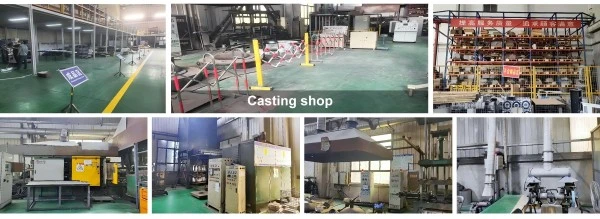
This is a casting motor end cover that was made with High Casting and CNC machining. These pieces show how motor housing parts are made to protect the motor, keep it cool, and keep the structure strong, even in very precise situations when accuracy is very important.
Having established the core functions of motor housing, it is important to recognize that these functions are heavily influenced by the materials used and the manufacturing processes employed. The choice of material and method directly affects the housing's ability to protect, dissipate heat, and support internal components, making them key considerations in motor design.
Materials Shaping Motor Housing Performance
Beyond its core functions, the performance of motor housing is fundamentally determined by the materials chosen and the manufacturing processes employed, as these factors directly influence durability, heat dissipation, and cost-effectiveness. Engineers select materials based on the motor's power rating, operating environment, weight constraints, and budget, while manufacturing processes are chosen to achieve the required dimensions, precision, and structural integrity.
Metals are the most common materials for motor housing, with aluminum, cast iron, and steel being the primary choices. Aluminum alloys are widely favored for their excellent combination of properties: they are lightweight (reducing overall motor weight, which is critical in applications like automotive or aerospace), have good thermal conductivity (aiding heat dissipation), and offer sufficient strength for many low-to-medium power motors. Additionally, aluminum is corrosion-resistant and can be easily machined or cast into complex shapes, making it versatile for diverse designs. Cast iron, by contrast, is valued for its high strength and durability, making it ideal for heavy-duty industrial motors that operate under high loads or in rugged environments. Its high density provides excellent vibration damping, but this comes at the cost of increased weight, which limits its use in applications where portability is important. Steel, particularly stainless steel, is chosen for its corrosion resistance and strength, often used in motors exposed to chemicals or moisture, such as those in marine or food processing equipment.
Non-metallic materials are also used in specific scenarios, primarily for low-power motors or applications with strict weight requirements. Engineering plastics, such as polycarbonate, nylon, or polyester, offer advantages like low cost, lightweight construction, and resistance to corrosion and chemicals. They are often used in small appliances (e.g., fans, blenders) where the motor's heat output is minimal and structural demands are low. Composite materials, which combine plastics with fibers (e.g., glass or carbon fiber), are gaining traction in high-performance applications, as they offer a balance of strength, lightness, and heat resistance, though their higher cost limits widespread adoption.
Design Considerations and Industry-Specific Applications of Motor Housing
Given the critical role of motor housing in overall motor performance, its design considerations and applications across industries are equally pivotal to ensuring optimal functionality. Design engineers must balance multiple factors, including thermal management, ingress protection, weight, and compatibility with the motor’s internal components, while tailoring the housing to the demands of its intended industry.
Thermal management is a top design priority, as discussed earlier, but its implementation varies based on the motor's power output. High-power motors (e.g., those used in industrial pumps or electric vehicle drivetrains) generate significant heat, requiring housings with enhanced cooling features. This may include large, closely spaced fins to maximize surface area, or integrated channels for liquid cooling. In contrast, low-power motors (such as those in household fans) may rely on simpler, smooth housings, as their heat output is minimal.
Ingress protection (IP) rating is another key design consideration, defining the housing's resistance to solids and liquids. For example, a motor used in a food processing plant may require an IP69 rating, meaning it is dust-tight and can withstand high-pressure, high-temperature water jets for cleaning. Such a housing would feature tight seals, welded seams, and minimal gaps to prevent contamination. Conversely, a motor used in a dry, indoor environment (e.g., an office printer) may only need an IP20 rating, offering basic protection against large objects and fingers.
Weight and size are critical in applications where space is limited or mobility is required. Automotive motors, for instance, benefit from lightweight aluminum housings to improve fuel efficiency or extend electric vehicle range. In robotics, compact, lightweight housings allow for greater maneuverability while still providing sufficient structural support. Designers often use finite element analysis (FEA) to reduce material usage without compromising strength, creating thinner walls in low-stress areas while reinforcing critical sections.
Compatibility with internal components is also essential. The housing must be sized to accommodate the stator, rotor, and bearings with precise clearances to avoid friction or misalignment. For example, in brushless DC motors, the housing may include slots or grooves to secure permanent magnets in the stator, ensuring they remain in place during high-speed rotation. Mounting points, such as flanges or brackets, must align with both the motor's internal structure and the external equipment it drives, requiring tight dimensional tolerances.
For more information about our motor housing solutions or to discuss your specific requirements, please contact us at zhouyi@rongbaocasting.com or steve.zhou@263.net. Our team of experts is ready to help you find the perfect solution for your application.
References
- IEEE Transactions on Industrial Electronics. "Thermal Management in High-Power Electric Motors: Design Strategies and Materials." 2022, Vol. 69, Issue 3.
- McGraw-Hill. "Motor Design Handbook: Principles, Materials, and Applications." 5th Edition, 2020.
- CRC Press. "Materials for Engineering Applications: Properties, Selection, and Performance." 3rd Edition, 2019.
- SAE International. "Automotive Electric Motor Housing Design: Lightweighting and Durability Standards." Technical Paper 2021-01-0567, 2021.
- ASME (American Society of Mechanical Engineers). "Manufacturing Processes for Precision Motor Components: Casting and CNC Machining Guidelines." 2020.
- Elsevier. "Industrial Motor Enclosures: IP Ratings and Environmental Resistance." Journal of Power Sources, 2023, Vol. 550.

Learn about our latest products and discounts through SMS or email