Material Preparation: The Foundation of Quality
The journey of creating a casting mixer base begins with the careful selection and preparation of materials. Typically, manufacturers use ADC12, an aluminum alloy known for its excellent castability and mechanical properties. The main component of this alloy is aluminum, but it also contains trace amounts of silicon, copper, and other metals that improve its properties.
At Rongbao Enterprise, the material preparation process involves several crucial steps:
- Material Sourcing: High-quality ADC12 ingots are sourced from reputable suppliers. The quality of these ingots is paramount, as it directly influences the final product's integrity.
- Chemical Analysis: Before processing, each batch of alloy undergoes rigorous chemical analysis to ensure it meets the specified composition requirements. This step is critical for maintaining consistent quality across production runs.
- Melting: The ADC12 ingots are melted in specially designed furnaces. The melting process is carefully controlled to maintain the optimal temperature, typically around 660-720°C (1220-1328°F), to ensure proper fluidity without compromising the alloy's properties.
- Degassing: Molten aluminum is prone to hydrogen absorption, which can lead to porosity in the final casting. To mitigate this, the molten metal undergoes a degassing process. Inert gases like argon or nitrogen are bubbled through the melt, removing dissolved hydrogen and other impurities.
- Flux Treatment: A specialized flux is added to the molten metal to remove oxides and further purify the alloy. This step is crucial for enhancing the metal's flowability and reducing the likelihood of defects in the final casting.
The meticulous attention to detail in material preparation sets the stage for the subsequent manufacturing processes. It ensures that each mixer base starts with a foundation of high-quality, properly treated aluminum alloy, ready for the molding process.
Molding Process: Shaping the Future
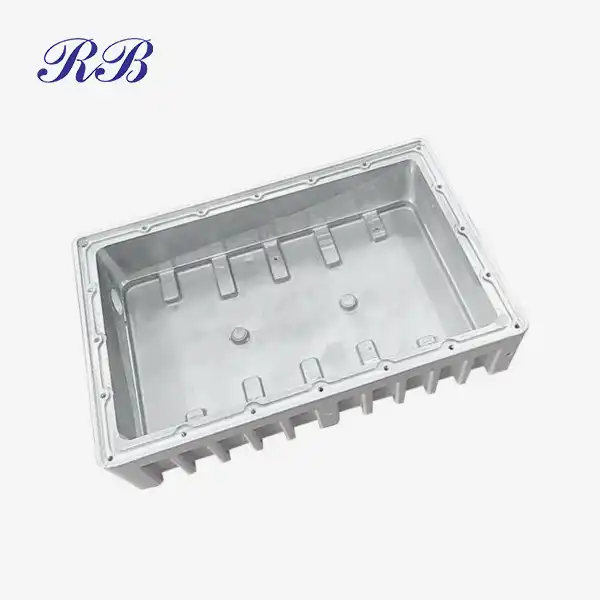
Once the material is prepared, the next critical phase in manufacturing the casting mixer base is the molding process. Rongbao Enterprise employs high-pressure die casting, a method that offers precision, efficiency, and excellent surface finish. This process is ideal for producing complex shapes with tight tolerances, making it perfect for the intricate design of a mixer base.
The high-pressure die casting process for the mixer base involves several key steps:
- Mold Design and Preparation: Engineers use advanced CAD software to design the mold, ensuring it accurately reflects the mixer base's specifications. The mold, typically made from high-grade tool steel, is carefully machined and heat-treated to withstand the high pressures and temperatures of the casting process.
- Die Lubrication: Before each casting cycle, the die is sprayed with a specially formulated lubricant. This step is crucial for preventing the molten aluminum from sticking to the mold and facilitating easy ejection of the finished part.
- Injection: The molten ADC12 alloy, maintained at the optimal temperature, is rapidly injected into the mold cavity under high pressure, typically ranging from 5,000 to 15,000 psi. This high pressure ensures that the metal fills even the finest details of the mold.
- Solidification: As soon as the molten metal fills the cavity, it begins to cool and solidify. The cooling rate is carefully controlled to ensure uniform solidification, minimizing the risk of defects like shrinkage porosity.
- Ejection: Once the part has solidified sufficiently, the die opens, and the cast mixer base is ejected using pins built into the mold. The part is then quickly cooled to room temperature.
- Quality Check: Each cast part undergoes immediate visual inspection for obvious defects. More comprehensive quality control measures, including X-ray inspection and dimensional checks, are performed on samples from each production batch.
This high-pressure die casting process allows Rongbao to produce mixer bases with exceptional consistency and quality. The process's speed and efficiency make it possible to manufacture large quantities of bases, meeting the high demand for these popular kitchen appliances.

Fine Machining: Precision in Every Detail
After the casting process, the casting mixer base undergoes fine machining to achieve the final dimensions and surface finish required for optimal performance. This stage is crucial for ensuring that each base fits perfectly with other components of the mixer and provides a stable foundation for the appliance.
The fine machining process at Rongbao Enterprise involves several sophisticated steps:
- CNC Machining: The cast mixer base is loaded into a computer numerical control (CNC) machining center. These advanced machines use precision cutting tools to remove excess material and create the final shape of the base. The CNC process allows for extremely tight tolerances, often as precise as ±0.05mm.
- Surface Milling: The bottom surface of the base is milled to ensure perfect flatness. This step is crucial for the mixer's stability when placed on a countertop.
- Drilling and Tapping: Holes are drilled and tapped in specific locations for attaching other components of the mixer. The precision of these operations is vital for proper assembly and function of the final product.
- Boring: Critical internal diameters are bored to exact specifications. These surfaces often interface with bearings or other moving parts, so their accuracy is essential for the mixer's smooth operation.
- Deburring: After machining, all edges are carefully deburred to remove any sharp edges or burrs. This process enhances both the safety and aesthetics of the mixer base.
- Surface Finishing: Depending on the specific model requirements, the machined base may undergo additional surface treatments. For instance, some bases receive a sprayed finish for improved appearance and corrosion resistance.
- Final Inspection: Each machined base undergoes a thorough inspection using precision measurement tools such as coordinate measuring machines (CMMs). This ensures that all critical dimensions meet the stringent specifications required for mixers.
The fine machining process transforms the raw casting into a precisely engineered component ready for assembly. It's at this stage that the true quality of Rongbao's manufacturing process becomes evident, with each casting mixer base exhibiting the hallmarks of superior craftsmanship.
The manufacturing process of a casting mixer base is a testament to the intricate blend of metallurgy, engineering, and precision machining. From the careful preparation of ADC12 aluminum alloy to the high-pressure die casting process and the meticulous fine machining, each step contributes to the creation of a product that meets the high standards expected of the brand.
Each mixer base not only satisfies but frequently surpasses the criteria for longevity, steadiness, and efficiency because Rongbao Enterprise maintains a dedication to quality throughout this process. Certifications in ISO9001:2015, ISO14001, and ISO45001 demonstrate their commitment to responsible production and the environment.
More efficient production processes and better products may be on the horizon as a result of ongoing technological process advancements. However, the core principles of material integrity, precision molding, and exacting machining will likely remain at the heart of producing these essential kitchen appliance components.

High Pressure Die Casting Suppliers: Your Partner in Quality Manufacturing
If you're in the market for high-quality die cast components like the mixer base, look no further than Rongbao Enterprise. As a leading high pressure die casting supplier, Rongbao offers unparalleled expertise in aluminum alloy die casting. With a production capacity of 5000 pieces and the ability to handle customized specifications, Rongbao is equipped to meet diverse manufacturing needs.
Whether you require OEM/ODM services, CNC machining, or specialized surface treatments, Rongbao's team of experts is ready to assist. Their commitment to quality is evident in every step of the production process, from material selection to final inspection. With certifications including ISO9001:2015, ISO14001, and ISO45001, you can trust in Rongbao's adherence to international standards of quality and environmental responsibility.
Don't settle for less when it comes to your manufacturing needs. Contact Rongbao Enterprise today at steve.zhou@263.net or zhouyi@rongbaocasting.com to discuss how they can bring your product designs to life with precision and excellence. Experience the difference that a dedicated, skilled high pressure die casting supplier can make in your production process.
References
1. Campbell, J. (2015). Complete Casting Handbook: Metal Casting Processes, Metallurgy, Techniques and Design. Butterworth-Heinemann.
2. Davis, J.R. (Ed.). (1993). Aluminum and Aluminum Alloys. ASM International.
3. Lumley, R. (Ed.). (2018). Fundamentals of Aluminium Metallurgy: Recent Advances. Woodhead Publishing.
4. Groover, M.P. (2020). Fundamentals of Modern Manufacturing: Materials, Processes, and Systems. John Wiley & Sons.
5. Kalpakjian, S., & Schmid, S.R. (2014). Manufacturing Engineering and Technology. Pearson.