- English
- French
- German
- Portuguese
- Spanish
- Russian
- Japanese
- Korean
- Arabic
- Greek
- German
- Turkish
- Italian
- Danish
- Romanian
- Indonesian
- Czech
- Afrikaans
- Swedish
- Polish
- Basque
- Catalan
- Esperanto
- Hindi
- Lao
- Albanian
- Amharic
- Armenian
- Azerbaijani
- Belarusian
- Bengali
- Bosnian
- Bulgarian
- Cebuano
- Chichewa
- Corsican
- Croatian
- Dutch
- Estonian
- Filipino
- Finnish
- Frisian
- Galician
- Georgian
- Gujarati
- Haitian
- Hausa
- Hawaiian
- Hebrew
- Hmong
- Hungarian
- Icelandic
- Igbo
- Javanese
- Kannada
- Kazakh
- Khmer
- Kurdish
- Kyrgyz
- Latin
- Latvian
- Lithuanian
- Luxembou..
- Macedonian
- Malagasy
- Malay
- Malayalam
- Maltese
- Maori
- Marathi
- Mongolian
- Burmese
- Nepali
- Norwegian
- Pashto
- Persian
- Punjabi
- Serbian
- Sesotho
- Sinhala
- Slovak
- Slovenian
- Somali
- Samoan
- Scots Gaelic
- Shona
- Sindhi
- Sundanese
- Swahili
- Tajik
- Tamil
- Telugu
- Thai
- Ukrainian
- Urdu
- Uzbek
- Vietnamese
- Welsh
- Xhosa
- Yiddish
- Yoruba
- Zulu
Do the bearings in a gearbox mount in the housing?
Bearings in a gearbox do mount directly in the gearbox housing. The housing provides machined bearing seats—precision-bored recesses that hold each bearing in its correct position. Bearings are secured using methods such as press-fitting, snap rings, or interference fits, depending on the application load and speed requirements. The gearbox housing acts as the primary structural anchor, ensuring that bearings remain aligned under dynamic forces. Without a properly engineered housing, bearings would shift under load, causing rapid wear, heat buildup, and eventual mechanical failure.

Understanding Gearbox Housing and Bearing Mounting Basics
What Is a Gearbox Housing?
The outside case that holds gears, shafts, and bearings in a transmission system is called a gearbox housing. You can think of it as the gearbox's skeleton. It keeps everything in place, protects the internal parts from dust, water, and impact, and holds the lubricant. How well bearings work over time is directly related to the material and shape of the case.
How Bearings Mount Inside the Housing
When a gearbox is closed, bearings don't just float around. They fit into bearing seats that have been carefully machined and drilled into the walls of the housing. Press-fitting (interference fit), snap rings (which lock the bearing axially), and bolted bearing caps (which clamp the upper race in place) are the three most common ways to put something. Each method works with a certain type of load. For radial loads, interference fits that are tight are best, while snap rings or end caps are often used for axial retention to keep things from moving.
Bearing life is affected by the way a house is designed. SKF's assembly instructions say that an imbalance of as little as 0.1° can shorten the life of a bearing by up to 30%. For most commercial uses, the bearing bore's machining tolerances must stay within the H7 range to ensure a good fit and even load distribution.
Key Factors in Gearbox Housing Selection for Bearing Support
Material Choices and Their Trade-Offs
The material used for the housing affects how well it handles heat, how rigid it is, and how much it weighs overall. These are the three materials that are most often used in industrial gearbox housings:
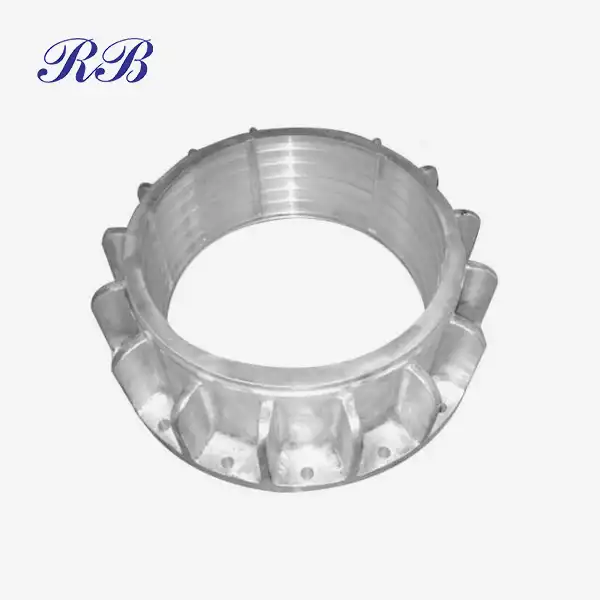
- Aluminum alloy (e.g., A380): Aluminum is about a third the weight of cast iron, but it conducts heat well and doesn't rust. It works well in high-speed, moderate-load situations where heat reduction is important. Our fire pump reduction housing is made of 14.8 kg of A380 aluminum alloy that was cast and then machined and shot-blasted. This gives us tight limits on dimensions without losing weight savings.
- Cast iron: Preferred where high compressive strength and low vibration are important. Heavy-duty industrial drives work better with cast iron because it absorbs resonance well. It is heavier and doesn't fight rust as well as aluminum, but it works great in places with a lot of load and slow speeds.
- Engineered plastic: Applied in low-torque, lightweight situations where reducing noise is very important. Plastic housings do a good job of reducing gear whine, but they don't have the structural depth that bearing seats need to withstand heavy radial loads.
These important differences have a direct effect on decisions about what to buy. If you choose the wrong material, the bearings will fail early, the housing hole will warp from heat, or equipment that needs to be light, like fire pumps, will gain weight that it doesn't need to.
Design Variations That Affect Bearing Performance
Open housings make it easier to do upkeep, but they also make it easier for contaminants to get into the bearings. Closed, sealed housings keep bearings safe in tough conditions, which is very important for fire pump gears that work in dirty or wet conditions. Integrated bearing seats that are carved directly into the housing wall get rid of the accuracy stack-up that comes with having different bearing carriers. Modular designs, on the other hand, let you change the bearing carrier without having to throw away the whole housing. This lowers the cost of long-term upkeep.

Practical Insights — Installation, Maintenance, and Repair
Correct Bearing Installation Procedures
To place a bearing correctly, you must first compare the bore width to the bearing's outer race tolerance. If the bore is too small, the bearing will crack when it is pressed into place. If the bore is too big, the outer race can spin, which breaks the housing seat. Never use a hammer to seat bearings; instead, use an induction heater or a hydraulic press. Hammering the raceways can damage them.
After fitting, use a dial indicator to test the axial clearance and make sure that the snap rings or end caps are fully in place. Before closing the housing, make sure you use the right grade of lubricant. In normal situations, grease-lubricated bearings in fire pump gearboxes need to be re-oiled every 2,000 hours of use.
Recognizing Damage and Deciding Repair vs. Replacement
Strange noises (rumbling, clicking, or screaming), oil leaking at the housing joint, and a shaft that isn't lined up right can all be signs that the bearings or the housing hole itself need to be fixed. If a housing bore has worn past the H7 tolerance limits, which can usually be seen with a bore gage, the seat can be fixed by re-machining or inserting a sleeve instead of replacing the whole thing. If the covering has cracks, holes, or deformations from being too hot, it needs to be replaced. In the case of a fire pump, putting off repair can have legal and safety effects.
Comparative Analysis to Guide Procurement Decisions
When looking for a gearbox case for a bearing-critical job, the choice between aluminum and cast iron comes down to the load and the surroundings. Cast iron housings are about 60% heavier than aluminum ones. This means that shipping costs are lower and building time is shorter. When big shock loads are applied above 500 rpm, cast iron works better than aluminum. The technical community agrees that A380 aluminum alloy is the best material for fire pump reduction housings because it is lightweight, makes installation more flexible, and is great at managing heat.
When it comes to accuracy, custom housings made around specific bearing bore patterns work better than off-the-shelf designs. To get the right bearing fit in a normal catalog housing, shimming or adapter plates may be needed. This adds time to the assembly process and increases the risk of tolerance issues. Those steps are not needed with a custom-machined case that is made from the buyer's exact drawing. In wet industrial settings, sealed housing types with O-ring grooves and sealing faces are required. This keeps water out of the bearing lubrication and increases the time between service intervals.

Procurement Insights — Sourcing Gearbox Housings with Optimal Bearing Mounts
To find a trustworthy gearbox housing maker, you need to look at three things: the ability to cast in more than one way, approved quality management, and past experience with OEM and ODM projects.
In their product brochures, major bearing names like SKF, Timken, NTN, and Schaeffler list the housings that are compatible with their products. Before approving a supplier's drawings, procurement teams should compare the tolerances for the bearing's outer race with the specifications for the housing bore. Ordering in bulk from a single source that does casting, machining, and surface treatment all under one roof cuts down on precision drift between suppliers and speeds up wait times.
Rongbao Enterprise is approved under ISO 9001:2015, ISO 14001, and ISO 45001 and makes fire pump reduction housings out of A380 aluminum alloy. They finish the housings by sand casting, CNC cutting, and shot blasting. Rongbao can make up to 5,000 pieces at a time and offers full OEM/ODM support. They deliver unique specs and ship big casts (14.8 kg) in wooden boxes to protect them during transport. Seventy percent of the production goes to Europe, North America, and Japan. This shows that the company always follows international standards for quality and size. The company has been making things for 20 years and can handle everything from fast development to mass production all through a single supply chain.
Conclusion
In a gearbox housing, the bearings fit exactly inside the case thanks to machined bearing seats. They are held in place by interference fits, snap rings, or end caps. How long those bearings will work consistently depends on the material of the case, the tolerance of the bore, and the design of the seals. When it comes to fire pump gearboxes, where a broken part could be dangerous, you must choose a housing made to exact specifications from a qualified, experienced provider; it is the basis of a reliable drivetrain.

FAQ
Can bearings always be mounted directly in the gearbox housing?
In most gearboxes used in factories, yes. The main bearing seat is in the housing bore. A secondary bearing carrier or sleeve piece is used, though, when bore wear goes beyond what is acceptable. This means that the case can be used again, and the interference fit for the new bearing is restored.
What housing material best supports bearing longevity?
Aluminum metal, like A380, works well in most moderate-load, high-speed situations because it quickly loses heat and keeps the bore size steady within the working temperature ranges. When sound damping and compression strength are more important than weight, cast iron is still the best choice.
How often should gearbox bearings be inspected?
When used continuously, like in fire pumps, bearing state should be checked every 2,000 hours or once a year, whichever comes first. Noise monitoring, temperature measurement at the housing surface, and lubricant analysis are all parts of the inspection process. Unplanned downtime can be avoided by finding abnormal wear early on.
What certifications should a gearbox housing supplier hold?
Suppliers should have at least ISO 9001:2015 for quality control, ISO 14001 for environmental compliance, and ISO 45001 for safety at work. Most big markets need these three certifications for supply chains in the fire industry.
Partner with Rongbao Enterprise for Precision Gearbox Housing Solutions
Rongbao Enterprise is a qualified A380 aluminum gearbox housing seller with 20 years of experience in casting, ISO triple-system certification, and the ability to fully customize OEM and ODM orders. Our fire pump reduction housings are made to international standards and can be made in a proven 5,000-piece capacity. To get a custom quote right away, email our engineering team at steve.zhou@263.net or zhouyi@rongbaocasting.com, or go to rongbaocasting.com.
References
- SKF Group. SKF Bearing Installation and Maintenance Guide. SKF, 2021.
- Norton, Robert L. Machine Design: An Integrated Approach. Pearson Education, 2020.
- Shigley, Joseph E., and Charles R. Mischke. Mechanical Engineering Design. McGraw-Hill, 2019.
- American Gear Manufacturers Association. AGMA 9005-F16: Industrial Gear Lubrication. AGMA, 2016.
- Harris, Tedric A., and Michael N. Kotzalas. Rolling Bearing Analysis: Essential Concepts of Bearing Technology. CRC Press, 2006.
- Budynas, Richard G., and J. Keith Nisbett. Shigley's Mechanical Engineering Design, 11th ed. McGraw-Hill, 2020.
Learn about our latest products and discounts through SMS or email